The Future


 RSS Feed
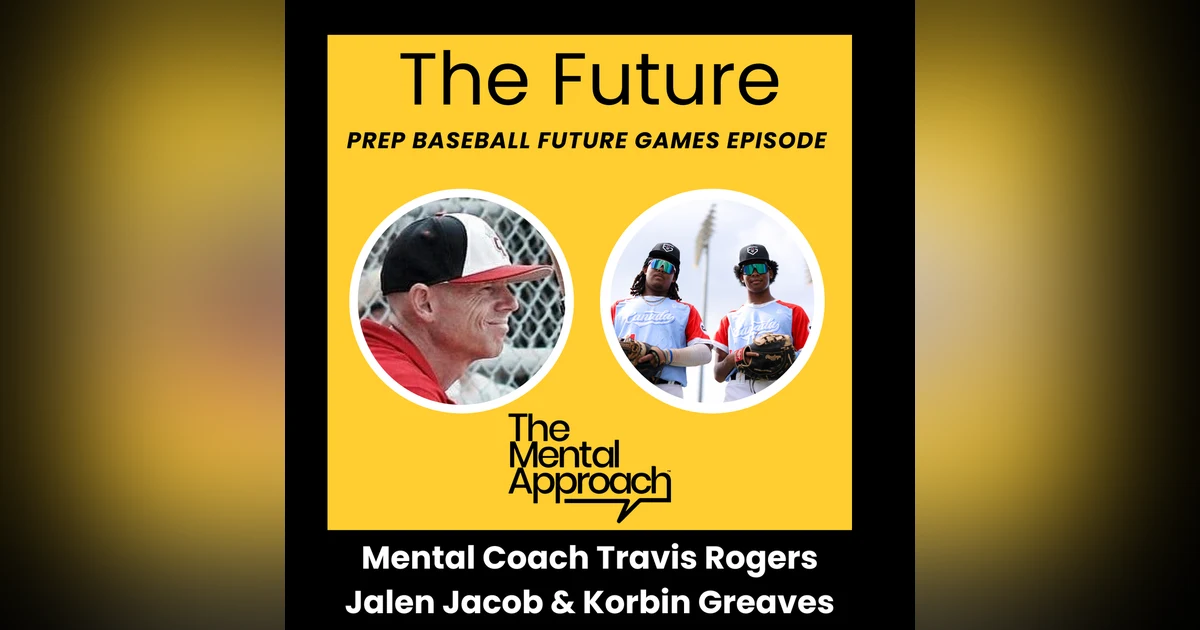
 In this episode of The Mental Approach, host Todd Arkell engages with mental performance coach Travis Rogers and young athletes Jalen Jacob and Korbin Greaves in preparation for their participation in the 2025 Prep Baseball Future Games in Atlanta Georgia.. They discuss the mental aspects of playing baseball, including personal journeys, mental preparation, handling pressure, setting goals, and the importance of routines. The conversation also touches on the impact of social media, the transfer portal, and balancing academics with athletics. The athletes share their insights on maintaining a positive mindset and learning from failure, emphasizing the importance of being the best version of oneself.
See Privacy Policy at https://art19.com/privacy and California Privacy Notice at https://art19.com/privacy#do-not-sell-my-info.
Matt Cundill 00:01
Matt, this is the mental approach where we discuss mindfulness, mental performance and the tools available for coping in a high performance world. Here's Todd Arkell,
Todd Arkell 00:12
today we have a treat for you. I have with me. Travis Rogers, mental performance coach from Arizona, author of a book called parenting athletic kids. Travis has been a guest on the show before, still remains one of the most downloaded episodes on a weekly basis. Lots of parents wanting to get insight in how you parent athletic kids. And also, we have Jalen Jacob, who is a 2027, grad year player based in Ontario, plays for the Ontario Blue Jays plays first base and third base, and we have Corbin Greaves plays for the Ontario Yankees, also a 2027, grad year he's a left handed pitcher, a first baseman and an outfielder. Oh, to have a lefty in the family, wouldn't that be great guys. Welcome to the show.
00:57
Not excited to be a part of this. I
Todd Arkell 01:00
think how this started was, I started talking to Josh from prep baseball report here in Ontario as they were doing their tryouts for the future games that PBR holds down in Atlanta every year. And I said, you know, I'd love to get a couple of young players on with a coach. Kind of talk through things a little bit. How do you handle yourself when you're at an event, when there's all these eyes on you, all these coaches, you've got a goal of trying to go play college baseball, especially for Canadian kids. You know, it's, it's super foreign for, I think our guys, in a lot of cases. But you know, as as you go forward, I think it's, it's good to get some tips and tricks to kind of handle yourself from a day to day basis. So that's how we got here. I'll start. I'll ask Jalen, can you share maybe a little bit of a brief overview? How did you how did you kind of get drawn to baseball, and what drew you to the sport?
Speaker 1 01:53
As a young kid, I always had a love for baseball, but also I love for other sports as well, right? So choosing between baseball and these other sports. It was a hard decision for me to make, but one person who really helped me, like overcome that decision was my brother. Seeing him playing baseball over the other sports is like soccer and hockey and stuff, it just made me want to follow in his footsteps and want to do that same sport.
Speaker 2 02:17
Corbin, same with Jalen, my brother. He always played baseball from a young age, so watching him play as a little kid just drew me to the sport, and I've stuck with it ever
Todd Arkell 02:26
since. Well, fun fact, for those listening, if you if you're not familiar, Travis has parented a couple athletic kids who are both Division One baseball players. And do you think your younger son Drew was that? That it that he was following his older brother when, when they kind of got along.
Speaker 3 02:41
That sounds very familiar, yes, sir, yeah. A little extra push, a little extra competition, seeing the good, the bad and the ugly of what older brother has gone through and making some adjustments, yeah? Like, I think that's that's huge. That's fun to hear
Todd Arkell 02:58
right now. I mean, you guys are what? 15, right? 15. So, just so young. That's crazy. Carbon. We'll start with you on this one. Do you have any mental preparation that goes into playing? Is there any kind of mental performance ideas that you're using right now to kind of get you through games? Or are you just sort of, oh, natural? You're not working working on anything specific,
Speaker 2 03:21
you know, I just like to go there. Have fun, compete, do my best. But before games, I always stick to a routine, you know, have a good meal before the game, and have a good stretch, warm up with my teammates and stuff, and just get locked in for the game.
Todd Arkell 03:35
Pretty much got you. Jalen, anything you do for me?
Speaker 1 03:39
I just try to remember that baseball is just a game to have fun. Just try and play the game to the best of my ability, the best game that I could play.
Todd Arkell 03:46
There you go. Seems pretty simple. Keep it simple, Travis, I'm going to take it over to you and maybe let you ask the guys a few questions and kind of maybe share some things based on what their what their answers are.
Speaker 3 03:58
Well, first off, I love it like you guys are practicing the mental game, and maybe don't even know it, by focusing on having fun, focusing on being the best version of yourself, focusing on your routines, focusing on being competitive every time you step on the field, those are mental skills that are just super important. So that's really cool to hear. I don't know if you guys understand that's like part of a mental game, or just how you play. It doesn't really matter, like, if that's how you're going out, preparing yourself and here's how on approach the game every day, you're setting up, setting yourself up to be in a really good position. I think I'd start by asking, what's going to be different about this PBR event, are you looking at it any any differently than you'd look at any other event, this, this Junior National Games? Are you expecting to battle with confidence a little bit? Is there anything different than what you just normally every weekend? I know Jalen. You're down at the dub. WBA, and you know, that's a big tournament. Do you approach these big things any differently? What are your thoughts? Or is there for this one? Jalen, why don't you answer that first?
Speaker 1 05:11
I feel like the best way to approach these big tournaments is to take it as if you're at home, and to try and be as comfortable as you can within yourself. Cuz if you're comfortable within the game, then you could be relaxed, you could be loose, and you could play to the best of your
Speaker 3 05:24
ability. Really cool. Let me. Let me just stay with you for a second. So what kinds of things do you incorporate to keep yourself in that comfort zone?
Speaker 1 05:33
One thing that really helps is Muse it for me before the games, before I even reach to the diamond, I always like to keep my my AirPods in to just remind myself, just stay calm as I get to the diamond. I always like to keep my routine the same no matter where I'm playing, no matter who I'm playing against. So I feel like that kind of helps me stay comfortable. And then, like in my in my zone, love it.
Speaker 2 05:54
Corbin, how are you? Man, yeah, I take it as the same. Just go out, do your thing like it's a regular game in your regular league or season, and just same routine, doing the same thing as I would as any other day.
Speaker 3 06:08
Love it. Is there expectations built up around this and also, so this will be lots of college coaches, highly scouted event. So does it bring any extra nerves or excitement or carbon? What are your thoughts on that?
Speaker 2 06:26
I mean, yeah, it does. Like for me, it would be like one of my first times playing in front of a whole bunch of scouts and stuff. But you know, as my coach and parents just say, just do you and just try to do your best, do whatever you know, just comes naturally.
06:41
Love it. Jalen, any thoughts on that?
Speaker 1 06:44
I feel like the best way to like play as yourself, even though you're surrounded in like a high, high profile area, is to just remember that baseball is just it's just baseball, like you're just there to play the game that you want to play. You're not there to impress anybody. You're not there to show anybody how good you are. You don't have to prove anything to anybody else. You're just there to play your game and have a good time. That's why I feel like the best way to stay relaxed when there's a lot of people watching your games,
Todd Arkell 07:13
these guys are too mature.
Speaker 3 07:14
Travis, yeah, you guys are killing it. I'm gonna try to put your feet to the fire a little bit more like say, say, we go into this event, and is this event, it's just games. Is that right? Or are we doing some skill testing stuff too?
Speaker 1 07:29
I think the first day is skill testing, okay, and then every other day is games,
Speaker 3 07:33
okay. Is there any expectations, nervousness around let's start with the skill side of it, like I want to do. I want to get that 60 at 7.0 whatever it might be, Jalen, any, any kind of expectations set around that.
Speaker 1 07:52
When it comes to me, I feel like, Yeah, I do want to get to the there's certain numbers, like my 60 time, I would obviously love to decrease that as such a big guy, like I would like to be as fast as possible, but I try not to worry too much about it, because even if you don't get the times you want to get, being nervous about that isn't really going to help you going later on into the tournament, right? Like worrying about your 60 time isn't going to matter two games into the tournament when you're up to the plate. So I try not too worried too much about my times, but I do try to focus most on increasing my 60 and my infield below, because my bat is something that's so prominent already right
Speaker 3 08:32
now. Really cool. How about when you go into like so I assume you'll have a round of BP. They'll be testing exit, V, lows, videoing you. You know that whole thing. How do you approach that?
Speaker 1 08:43
That BP, BP is definitely probably my biggest where I show the most. So I try not to, I try to keep it as calm as possible. I try to not think about hitting the ball as far as I can. I try to think about keeping my swing as smooth and as clean as possible, so that even if my Miss hits I still get good swings on them. So me being like, having so much power me had, like, my Miss hits will still go a decent way. So I'll just try to keep it as consistent and as, yeah, like, line drives gap to gap as possible.
Speaker 3 09:14
Is that your mindset going in just stay smooth, line drives gap to gap and kind of just reminding yourself of that because you said a couple things like, I don't want to do this, which athletes can get in big trouble with, yeah. I mean, I don't want to pop up three times in a row, right? I don't want to roll over ground balls. And you didn't say all that, but you said a couple like, I don't want to, but then you've backed it up with, here's how I want to approach it, which is huge, which is super important, so keeping the positive, which is, which can be really hard in baseball because we use so much lingo and jargon that's, you know, don't swing at the high pitch. Don't do this. Don't. That? Well, I need answers, right? So the answers, it sounds like real, really cool, like I'm going in there nice and easy thinking, line drive, gap to gap, whatever might be that's that's super cool. Really good. Corbin, how about you? Like the the testing kind of stuff, any expectations, nervousness around that stuff.
Speaker 2 10:23
I mean, for the testing, you know, I always want to do better than I did previously. So other events that I went to, I always want to better my numbers, but I just see it as like a benchmark to see what I need to improve. And just use that as something that like a tool that I could use to always improve my game. And you guys,
Todd Arkell 10:40
are you a two way on the roster? Carbon, yeah. Now typically, do you start or do you relieve? I usually start interesting. And what do you like better?
Speaker 2 10:51
I like starting usually, because, I mean, for my team, our roster isn't that big, so usually when I relief, I don't have that much time to warm up and do all my prep. So starting gives me the whole, like, hour and a half before the game to get
Speaker 3 11:06
ready. Let me just say on that another for listeners like you guys are really killing it. I love that, that you said, like, it's a benchmark and just a tool. Like, yeah, we want to go in there and have our highs a little better than we did last time, but so many kids go in here and want to do, let's just talk exit below like I want to jump up five miles an hour in my exit vehicle. Well, we know that takes what that takes work that takes strength, that takes eating. It takes all these things to jump up that. But yet some guys just think, like, that's what I want to do. And then if they do or don't do that, they get really, either really high or really low, whereas you where, whereas you said, I'm using it as a as a tool for growth, and that's super important in in this event and tournaments and games and showcase type stuff every if you can learn from every single thing along the way, what do I need to work on? What do I need to do better? What can I push a little harder at any age, but especially at your guys age, like the steps, the jumps up, are way more consistent, and there's way less highs and lows. So for athletes out there listening, if you, if you have, we call it a growth mindset, right? If you have this growth mindset of, I'm here to learn, grow, get better. It changes everything. You know, the pressure just goes whatever happens. I'm going to go out here and get my best, but whatever happens, I'm gonna learn from it. Man, that's that's super empowering, and also it's super relaxing. It removes a ton of stress. So, so really good.
Todd Arkell 12:55
Like, obviously you seem to have the right approach to it. You're not taking it, I won't say too seriously. Obviously, you're taking it seriously. But you know what I mean, you're not putting doesn't seem like you're putting a lot of pressure on yourself. But is there anything you're you do outside of, you know? I guess I find everybody, you know, extra hacks, bullpens, whatever, all these different things people do, sprinting, you know, what are you doing to practice sort of that mental side. Are you doing any journaling? Are you meditating? Are you, you know, kind of doing any visualization? Is there anything like that that you that you actually have in your routine today,
Speaker 2 13:31
I use visualizing. I visually. I like to visualize success and visualize myself doing things that I want to do. That's one thing in my routine. Cool. Jalen, I feel
Speaker 1 13:43
like it's the same thing for me. Visualizing is really important. But I also like to make sure I breathe, because if I don't breathe, and I get all worked up and like, it's easier for me to all unleash it at once, instead of, like, me taking my breath, taking my time, and being able to slow down the situation.
Speaker 3 13:59
Really good two, great skills, really good. I think this is as we're getting into this a little bit Todd like, like, it's kind of hard, because if these guys feel really comfortable and tell me if I'm wrong guys, or maybe I shouldn't say, I don't know for sure that you feel comfortable going into this event, but it sounds like you do. It sounds like you have good approach to it, a good mindset. I don't want to add things, you know, to that, or say, Well, did you think about this, this and this? And you're like, Well, no, actually, I feel pretty good. So it's kind of tricky. I would say, for people doing this out there that maybe aren't as in greater position, and this might help you guys. As we were coming into this, I thought about what you want to do is kind of keep the end in mind a little bit. So as you guys go in into this, do you have goals? Let's not talk about the numbers part, the showcase kind of part. Let's talk. About the games like, what are your goals? How many games do we play? Do? Does that? Do we know that
Speaker 1 15:07
it's three to four? Last year was three, so it should be three to four this year,
Speaker 3 15:12
depending on how you do. Maybe you get into a championship game or something like that. Maybe it's within those games like Jaylen, do you have a any thoughts in mind about what your goals are going into this.
Speaker 1 15:23
I feel like some goals of mine are to get on base as often as possible and to make no errors. Those are two goals that I've set for myself, because when I hit the ball, when I make contact with the ball, most of the time, it's going to find a place to land, because I hit the ball with power. So with me, my two my goals are not make any errors on defense, hit the ball as hard as possible, as often as possible, and another goal is obviously to win the games. That's what's more than most important.
Speaker 3 15:50
So out of those goals you just listed, let's, let's take a couple of them. We don't have to hit on all of them, but you said, get on base as often as possible, hit the ball as hard as possible, as often as possible, no errors of those, just those three things. And we can also throw in like, win games. Of those four things are any of them you're like, in total control over like, I have total control over whether I get on base as often as possible, whether I hit the ball hard as often as possible, win games. Do you have total control over those things?
16:33
No, I wouldn't say you have control over those. Okay,
Speaker 3 16:35
so let's just take one of them. No errors. What are you going to do to give yourself? This is What's tricky about baseball. So So Todd, and you can back me, and you guys can back me up on this, I think, like we have, I've been talking a lot about confidence lately, and trust and all these things. And what I what I want you guys to do is walk into this event feeling really comfortable, confident, whatever you want to call it, right? And it sounds like you guys are there, if not really close to that. So how do we have confidence? Well, confidence comes from we've had success in the past. Jalen, you're talking about, you know, if I hit a baseball, it gets crushed. That helps confidence, right? Like that feels good. But with baseball, we're unsure if we can, for sure, succeed at what we want to succeed at. So the goal going up to the plate is to smash a baseball. But I'm not actually 100% sure if I can do that, because if you were 100% sure, if you could do it, everybody would be hitting 1000 Right. Like Aaron. Judge would never make an out. Vladi would never make an out. It doesn't work like that. So what we need to know are the things that give us the best chance success. So let's go back to nowheres. So what things do you do when you're in the field, or in pre game or wherever that give you the best chance of not making an error?
Speaker 1 18:10
Some things that could give me the best chance of not making errors is my pre game warm up, making sure I'm doing my build up properly. I'm taking proper ground balls and my mindset when I'm on the field. So thinking about the play before the play happens, depending on the runner, the batter, anything that's occurring in front around me.
Speaker 3 18:30
Love it. Beautiful. Really good. And so, so the point here being as athletes are going into things like this, thinking a little bit about what my goals are, and your goal might be, man, just have a ton of fun. Play with a bunch of energy. You can control those that's 100% within your control. But if a goal is not to make any errors, you know, hit every baseball hard, I don't have 100% control that, then I have to look at the things that I need to do that give me the best chance of hitting those goals, and go all in on that stuff, right? And the more you do that, and the more you learn. Well, that worked, that worked. I hit a bunch of balls hard, and here was my process for doing that, the controllable things, like you said, no errors. The controllable your process is taking really good warm ups before the game, doing things the right way when you step on the field, understanding if the balls hit to me, where am I going to make the play? Have good energy, good bounce in my step, whatever it might be. And then if you focus on that process and you get great results, what do you do? You repeat that process. You remember it, you write it down. You go to that if things don't go your way, like, let's just say in BP, you talked about BP and being line drive. Nice. Nice and easy. What if that round doesn't go the way you want it? What? What do you think then? What would what kind of what would you look at?
Speaker 1 20:08
I would try and find the best way to bounce back and turn that bad BP into a learning lesson for the next games to come up.
Speaker 3 20:16
Well, tell me more about that. How would you what would you look at to learn from that BP.
Speaker 1 20:22
I always like to watch over my swings and my rounds and stuff like as much as possible. But not only that, it's just feeling like my mechanics, as in like, in myself that are just moving like, smoothly.
Speaker 3 20:34
Okay, so, so you were just ask yourself, Was I feeling smooth? Yeah. Were my mechanics good? Those are, those are fantastic. So again, for listeners and for you guys
Speaker 1 20:45
also, yeah, I also do like to watch over tapes and like, look at the slings. Love it.
Speaker 3 20:49
Love it. There's definitely mechanical adjustments that that possibly could get made. The other thing is, any mental adjustments, any process adjustments, right? So there's always two things in baseball that you look at that didn't go the way I wanted it to go. What do I need to adjust physically and or mentally? Okay? Was I relaxed? Was I calm? Was I nice and easy? If not, what do I need to do to try to make myself more calm next time? Let's say I booted two balls playing defense. Is it something physical? Was I not? Was it my backhand? Do I need to work on my backhand? Was I not getting my butt down low enough? Or was it I wasn't mentally engaged. I wasn't wanting the ball hit to me. My energy was down a little bit. I was still thinking about my last at bat when I went out in the field. I need to get better at that part of the mental game. Let me kind of summarize that, and then Corbin, we want to get to you on this too. If you have goals, those are great. If they're not 100% within your control, you need to figure out the mental and physical process, the things that you need to do to give yourself the best chance of reaching those goals. If you reach those goals with that process, you say, I'm going to run that process back. If I don't reach that the goals with that process, I'm going to make adjustments physically and or mentally. It might be video. You might see something in your swing. I was dropping my back shoulder. I gotta stay tall. It might be my swings were awesome, but I wasn't. My energy wasn't right. You know what? I was dragging a little bit. I wasn't, I wasn't feeling trust in myself trying to drive ball, whatever it might be. So that's the process for constant growth and constantly focusing on I want to get better every day, and I want to stay right here, right? And you, you said a great thing. And then we'll get to Corbin. Like, I'm gonna also try to, like, put that in the rear view mirror. And now I got some games to play it. We're talking that. BV, like, that's huge too. Like, that was yesterday. Now, now what am I going to do in games? Let's put that behind me. That's really big, too. Jalen, did you have any questions about any of that before we get to Corbin? No, I
Speaker 1 23:25
actually think what you said is really interesting. I feel like finding, like, the deeper meaning behind your goals, and like finding out the stuff that can help you overcome those goals is a good strategy.
Speaker 3 23:37
Thank you. You've probably heard coaches, you know, people focus on the process. Focus on the process, and that's what the process is. In baseball, it's boiled down to physical and mental things that you need to do to give yourself the best chance of success. Like, I don't want you to go down there and just be like, willy nilly like, and I'm sure you won't, but that's not what the process is. The process is, how do I go out here and give myself the best chance of having a great round of BP? How do I go out here and give and you guys said so many great things. I'm having fun. I'm joking with my buddies. I'm gonna listen to some music. I'm gonna be the best version of myself, not comparing myself to anyone else. Like I'm going out here and being the best, those are all great things. I think a next level thing is just thinking about being mindful of, if I don't have 100% control of it physically and mentally, what do I need to do to give myself the best chance? I'll tell you a quick story, and then I promise, Corbin, we'll get you. You know, my son's out in the cape, and I'm not trying to throw him under the bus here, but I think he was over 13, and his first 13 abs. It's really easy to be like, Man, this is too much for me. Like, I'm a freshman out here. And these guys are, you know, this guy's from Tennessee, this guy's from Arkansas. You. Whatever. There's a million things you can go to where he just needs to go to. How am I swinging? How do I feel physically? How do I feel mentally? Am I doing the physical things I need to do to give myself the best chance in my abs? And it goes back to the pre game. What are you doing? It goes back to getting yourself ready on deck. We won't get into all that, but physically, am I ready? Mentally, am I ready? If it's yes, yes, keep plugging away. Like, like, keep going. It's coming. If there's doubt in either of those areas that doubt leads to a loss of confidence. So we need to confidence grows. And again, the confidence term, we could do a whole nother podcast on that, but trusting in yourself, believing in your process, believing in your mental and physical readiness. That's confidence so trusting that you're physically and mentally ready to give your best self when you step to the plate, boom, now we're talking. Now we're talking.
Todd Arkell 26:05
And I think it's easy when you get into a slump sometimes to say, I'm going to change my approach, or I'm going to change, you know, I'll give you a quick example too, with my son. He had a game he struck out three times, and he's like, shaking his head, but he watched the bats back. And he goes, my my swing felt great in BP. I'm looking at the bats. He goes, they were good at but he goes, I'm just missing the ball. Okay? And then next game he goes out. He hits a three run home run, right? So he just didn't change anything, or go, oh man, I gotta, I gotta have a loop de loop in my swing now, because I'm missing everything, you know, whatever, he just kind of stuck to the way he was doing things and kind of trusted it would work itself out. I think hitters need to understand and Corbin, you probably know this better than most pitchers are trying to get you out. It's man on man. So you may have the stuff as the hitter, but maybe the pitcher has something a little bit
Matt Cundill 26:59
different now, more of the mental approach with Todd Arkell,
Todd Arkell 27:04
let's go to you. Corbin, now that you've we wake you up from your nap as you sat there, we went we we go on. But what type of goals do you have going into the event for yourself?
Speaker 2 27:13
For me, I'm just trying to go out there, play my game, do as best as I can, but I really want, like, I know I'm going to fail. I know I'm going to strike out some of the best players in the country. So I just want to control my body language. Make sure, you know, I'm keeping myself, I'm keeping myself up, I'm not getting down on myself. And yeah, pretty much, that's it.
Speaker 3 27:34
That's good advice. I got nothing on that, man. Like those are controllables. It's hard you strike out. Yeah, you strike out. And oh, but how you're going to bounce back faster from that is what you just said. Really good body language, really good energy. Get up. Cheer on the next guy, like, let's not Willow. And that's a whole, you know, again, that's a whole mental performance podcast is responding to failure, responding to adversity. But those actions, you can control, your body language, your actions after something bad happens. And if you have control over that, you got a way better chance of doing something good when you get back out in the field, when you get up for your next at bat again, that that gets hard, but 100% controllable, though I love those. And you guys have said a bunch of times, be the best, best you can be. Be the best version of yourself for you guys at this that's a huge one. You guys don't know how huge that is. So many guys your age struggle with that, guys, girls. What up? It's so easy to get into comparisons, you know, you're seeing it on social media. And this guy hit a 400 foot bomb, and this guy's running a six, 260 and, man, you know, I'm not doing that, that that's just going to take you down a bad path, like I just want to be a little better than I was yesterday. That's huge. So, I really love the fact that you guys both are bashing beating that drum over and over again. Really good guys.
Todd Arkell 29:07
It is something that talk about it a lot. Comparison is the thief of joy is probably the most famous saying. And it is probably so much harder for kids your age nowadays that everywhere you look, somebody else is on social media doing something and, Oh, they got 2000 likes, or they got this, or they got that, and yet, you're all on your own path. You're all on your own journey. You know, it might come quicker for some than others. And a lot of times, the people who are the most successful are the ones who just stay steady and plug away right like, and just continue being themselves and and just trying to get a little bit better, right? That's definitely a good attitude to have. So do you guys have questions for Travis?
Speaker 2 29:51
You had a question just about that is, like, what do you think about the social media presence that covers baseball, like rankings and stuff like, how it affects. Athletes.
Speaker 3 30:01
Well, the easy answer is that I don't like it, but there's some value to it, you know, if you're using it. And I think you guys talk about a really good approach to this, like with my kids and with people I work with, it's always go, go to the PBR showcase, see what you got use it as a tool. Where do I need to work? Where do I need to put in some extra effort? I'm going to stay locked in on the things that I do well too, and try to get better at those. But is there something and you can measure yourself against other people in that regard, right? If it challenges you, if it pushes you to be better, but it's bad. If it gets you down, if you ride a roller coaster of emotions from that like then it's bad. And sadly, I think that's what most people do with the rankings and, and, and, well, you said a Todd like Noah got on, got on Twitter. Was this or an X, was this big blast out? Like, how did that affect them? Was it useful, or was it harmful? Or was it,
Todd Arkell 31:08
my message to him was it's all kind of intoxicating when all of a sudden people are all over you, and you know it, you know it's, it's, it's easy to be excited, but you have to try to maintain be the same person you are, kind of what we've been preaching. I mean, I'll drop a bar on this one where I think about social media, where people are giving you flowers all the time and pumping your tires and everything. If you're a fan of Biggie Smalls, never get high on your own supply. Don't take yourself so seriously, right? Especially when you know everybody is pumping your tires. And I've seen it a lot with junior hockey players, where guys are highly touted, and as you guys get closer and closer, you're going to see right now, I know both of you guys are really highly touted players, but the pond gets smaller and the fish get bigger, right? And it starts to be all of a sudden, you have to just be confident in who you are and your ability to do things, because as you go further and further, everybody was the best player on their team. I think the San Diego Padres. Here's a good one. I don't know if anybody knows this. There's they had a starting lineup the other night. Everybody on the field had been a shortstop in the MLB. It's like, okay, so every guy there was the starting shortstop on their MLB team, and now they're playing different positions, right? So it does get as you kind of ratchet it up, right? Like you were the best player, and now you're like, Oh no, I'm the fifth best player, but still you're the fifth best player. There's nothing wrong with that either, right? So it's kind of having that mentality that you're not going to take your self too seriously, like I'm the greatest. The fall is big when it doesn't go your way. There's no question about it. Yeah.
Speaker 3 32:48
Corbin, I think another that's really good. Todd, I think another good approach to it is, if you're using those rankings and things to motivate you off the field, it gets you out of bed a little earlier. It gets you to push some extra reps in the weight room. It gets you a couple extra rounds of BP, whatever. Great. My younger son, this wasn't as big when my older son was going through what you guys are going through. It's, it's really blown up the last five or six years. But so my younger son was was playing the rankings game. You know, he did a PG thing and got ranked a 100th or something like that, and he's like, Man, I can, I can pass this guy, that guy and that guy, I want to be ranked here. And that was fine off the field, because it pushed him a little bit. Now we don't want that to be the we what we talk about being motivated from within, but we can sprinkle in these little exterior motivators for a little push. And I won't get into all that, but so he got a little push from that, but when he stepped on the field in games, it that had nothing to do with how he played. He couldn't have that in his ear, in the back of his head. You know what I got to do better than this catcher that we're playing against because He's ranked 15th and I'm ranked 30th. Like, that's just noise. That's a distraction that's taking you out of the player that you want to be. To summarize that, like, if it helps you off the field, great, once you step on the field, you're being the best version of yourself. It has nothing to do with anybody else.
Todd Arkell 34:20
Use it for motivation. I mean, I know a 2028, Canadian kid who wasn't ranked anywhere, and thought he was a better player than what everybody thought he was, and he just kind of stuck the rankings on his wall and said, All right, I'm going to work. And I think he's passed most of those kids now. He's got a got a lot of things going on for him. And I was watching a Monroe st Brown from the lions the other day. There was a short story, and he was talking his dad was Mr. Universe two times. So his dad was totally like, driving the boys right, like he said, You're going to make the NFL. Like this is like, they're 1011, years old. You're making the NFL. And Amon rod. Tells the story. Says, well, there was a kid that was playing he, you know, my dad said, Oh, your son's got really good hands. How does you know? What do you guys do? And he said, Oh, we bought a JUGS Machine, and he catches 200 balls after practice every day. So his dad goes, All right, we're getting a machine, and you're doing 202. We're going to get better than him, right? And he's still to this he's in the NFL. He still catches 202 balls off a JUGS Machine after practice every day. So using things for fuel is definitely, definitely a good thing. I don't disagree with that. You and I think you got to have reasons to get up in the morning and do that lift. Or, you know, especially when you're students, right? You got a lot of things pulling at you. It's a different thing when you can be a, you know, a professional, or you can just play a sport and you don't have any other responsibilities, but to be a student and be a student athlete is a lot harder. There's a lot of there's a lot of responsibility. How do you find it out there? I mean, and I say lesser known, because there's, we'll call air quotes, name, name, you know, programs out there, and it seems to have served you just well. So, you know, talk a little bit about the program.
Speaker 2 36:13
I mean, I love it. Like I'm real nearby the facility. So like it's like a 10 minute drive away from me. I could go there whenever I want. Our coach owns it. So he opens it up. He go take hacks, work on Fielding, pitching, whatever. And, you know, shows it's a smaller team, less players on each roster of team. So we're like a family down there. It's just like, you know, we're all so close, closer to coaches. And, yeah, it's a
Todd Arkell 36:38
great that's awesome. Yeah, having a facility that close certainly makes it easy, doesn't it? Yeah, various, you know, when I look at the I look at the holiday boys, have you ever seen the facility they have in their backyard? Yeah, it's kind of hard to understand how they got so good play, it, playing on that stuff. So did you? Did you have any other questions at all that came to mind that you wanted to ask?
Speaker 2 37:07
We, yeah, I do have, I do have another one. It was what you just ended off on. It was like, how, what's any advice that you have with balancing academic sports and social life as a student athlete?
Speaker 3 37:19
I think everybody's different on that like, but I will say, at your age right now, if you can get really good at scheduling stuff, you know, whether it's Sunday night, like writing down, here's what I'm going to be doing from this time to that time. I'm in school, and then I have practice. And this is what I'm going to study. It's, it can be super, super valuable, that's and this will take you into college or wherever you go next, like if you get really good at at dominating your schedule, dominating your calendar, what you end up in. I know a lot of young guys don't believe this, but it actually provides you with more free time and better free time, because right right now a lot of guys like are in their free time, but they're thinking about, I should be hitting baseballs, or I should be studying or and it's actually sucking some life out of your free time, so everybody's a little bit different on that, I would suggest starting with the Sunday night sit down. Let's look at my week. Okay, I know I need to do A, B and C. I need to go to weights on Tuesdays, Thursdays and Saturdays, whatever it might be. Have a calendar. I got mine right here, and I write down things in my calendar so I can pop it open and I can look at the full week like I know when I need to be on this podcast with you guys. So I so then I can schedule in my free time. If I had baseball and school, those would be one and two and then, okay, I know on Tuesday night at six, I'm a free man, so that's how I would do that. You know, everybody's not to get parents mad at me or whatever, but, but everybody's a little bit different on emphasizing education, emphasizing baseball, depending on the person, like they're equally as important, like one shouldn't suffer because of the other. For sure, I'm going to get good grades and I'm going to do it's possible. I know, I know it can be hard, overwhelming at times, but I think I would just say, Todd, maybe you've got a kid, a kid at this age now that that it's just about understanding and being very good at scheduling stuff, taking the 15 minutes on a Sunday night to set myself up for success for the next seven days, and I'm good to go.
Todd Arkell 39:36
Yeah, I agree. And I'd say my guy has not been the best at it, but he's managed to juggle right and kind of stay on top of things. And know, hey, I got these many things are due this week, and I better crank them out. He personally just had the ability to crank out high volumes of work in a short period of time for whatever reason. Call it a superpower, you know? So he could sit down and write an essay in an hour that might take other people 10 hours. So, you know, he had certain abilities. He was just he was talented at writing. So those types of classes were easier for him, and it was interesting. So I think it is, though organization is a big thing. I know we visited, I know we visited your son on the campus at Michigan, and, you know, he had just finished practice, took like, 10 or 15 minutes, gave us a little tour around the facility. And then he was off to, he was off to do some homework and join a mental performance call where, you know, he was talking to some different people. There was a kind of a weekly call, but he said, Oh, and then I got an hour worth of homework, and then, kind of rinse and repeat, he knew exactly what was on his agenda that night, right? And made a few minutes for us. And it was great. And I think you just have to try to stay organized. If you can figure out how to use a calendar, that's helpful. And it's not just, I've always kind of looked at it this way. This is, I'm really, I'm really, I don't use the paper calendar like Travis anymore. I'm Mr. Electronic, because I just figure I got my phone everywhere, literally, something like, Hey, this essay is due on this day, and it's seven days away, and I need to, I need, say three days to be able to write my essay. That's something that you can look at and kind of go, Hey, this is, this is how it goes, right? So I'm going to put that date in my calendar three days earlier or four days earlier, so I can be done the day before. And looking at your practice schedule, and you're getting, you know, when am I going to have the time to put that thing together?
Speaker 3 41:43
Corbin, Matt, just, just the fact that you're that you're asking that question at 15 years old is, tells, tells me you're in a pretty good place and, like, on your way to be okay in those areas, did what Todd and I went through, like, answer that question for you, or was there some more depth that you were thinking too with that?
42:04
Oh, that was great. That was good. Cool, awesome.
Todd Arkell 42:08
So do you have any additional questions?
Speaker 1 42:11
Yeah, I had one question for Travis. I had one question for Travis about from before that. I wanted to ask, um, I wanted to know, I wanted to know, if you think that the transfer portal applies any extra unwanted stress to players that are in college currently,
Speaker 3 42:26
woo, for sure, my son went into the transfer portal. I guess I don't know. I mean, it's not the transfer portal itself that applies stress. It's the thoughts about, why am I transferring? Should I transfer? I don't see it changing anytime soon. So and every kid's different on why they're going into the transfer portal, and their thoughts on the portal. For my son, it was pretty easy. He was in the transfer portal for like, 48 hours before he committed to Michigan, his story is a little different. He actually got recruited by Tracy Smith to Arizona State, and then Tracy Smith and his staff got fired from Arizona State and went to Michigan. My son stayed with this commission commitment to Arizona State. But then when he decided to transfer, one of his first calls was from Tracy Smith at Michigan, and boom, away he went. So actually, the transfer portal itself was like, not stressful at all for him, but for sure, it's it's a hard place right now and again, we could do a whole separate podcast on that, but I hope the kids that are going into the transfer portal have really thought about, what are they not happy about where they are now, is it? Is it legit things and talking through that with people, friends, teammates, family? Why am I not happy where I am? Because the grass isn't always greener by transferring. But again, that's just, I mean, we could go around and around on that. Does that help at all? Like, what are you worried about? It for, bro, you're 15 years old. You got
44:19
just curiosity. Just curiosity.
Todd Arkell 44:22
Okay, yeah, I would say I have, I have thoughts on it. And again, I don't have a kid in that situation yet, but I can also argue that Travis's son Will was a catcher behind a really good catcher, and so he wasn't going to play if he stayed for another two years. And for his own, you know, his own playing time, that made sense. I think those types of things are pretty valid that you get caught in a system where you got an All American ahead of you, and he's a, you know, he's a junior, and he's gonna, you know, like he's gonna play for the next two years, and that's it. And you're probably not. I. I can see that. I think, really though, I think when you go somewhere and maybe you're not getting played, you kind of got to look at yourself first. I think is like, what have I done? Have I done everything I can to make myself get into the lineup right? Like, what have I done? And even a little bit of prop to a previous episode I had with it, with a Canadian kid, Cooper Davis, who went to Vanderbilt, and he tells the story. He said, look at I was calling every week, back to people going, I hated here. I gotta go home. This is, this isn't for me, because he wasn't getting he was a freshman. He's not starting right. And he was, it was school was kicking his ass, and he wasn't playing baseball, so he was, like, unhappy. But you know what, korbs sat him down, and he hooked him up with a couple of seniors and had a conversation. You know what? Eventually, he just kind of toughed it out, is really what happened. And then, you know, they go, you're here because we want you to be part of this team, right? You're gonna grow. And I guess his comment was Sean travers, who's a coach here in Canada, was was Cooper's coach at the time. And Sean said to him, look at if you went to a power five school and you start as a freshman, you had a terrible agent, meaning you should have got big money in the draft. You're probably if you're good enough to go to a d1 school and a big program, chances are you might not play much as a freshman. It's probably true, right? And you have to think about it. Is it because you're not good enough? Is it? You know, it's probably not because the coach hates you. He brought you there, right? Like, there's a lot of different reasons, and I think we have to get out of this mentality of people hopping program to program just because, oh, I didn't like that guy, or I didn't like this or whatever, right? You gotta, you gotta have a little little bit of, little bit of grit to kind of tough it out. I think so. Travis, let me ask you that question, how was Drew's experience this year at Georgia like he was a freshman. Did he play much?
Speaker 3 47:04
So Drew was catching about every third game. To start, he had a little sickness that ended up he was out of the lineup, and he didn't get back up and into the lineup for probably six weeks. So those were like, really hard six weeks, but he stuck with it. He stuck with it. He got back up in the in the lineup one game, had a really good game, and then was in the lineup the last four or five weeks of the year. Um, but there's Todd talking about, you know, some really good player in front of him. He had a kid, a sophomore, that just had a fantastic season as a catcher, hit 350 just a great defensive catcher. He's now on the USA collegiate team. So he's a great player, and he's coming back again next year. Okay, so he'll be a junior next year. My son will be a sophomore. So I'm going to be honest, like there was discussion like this kid, he's not going anywhere. He's really good. So Drew had to balance playing time. He could go, probably transfer somewhere else and be the guy and play all the time, but he had to balance it. College isn't just about that. He loves his teammates, he loves his coaches, he loves the campus. He loves his roommates. He feels like he's getting coached really well, getting better every day, and having this kid in front of him is a kid to learn from, so he might not well he's not going to play 100% of the time behind the dish like he probably could if he went somewhere else. But for him, all these other things were more important than that, and also to Todd's point. Like, at some point, if you guys get drafted or Drew, gets drafted, or whatever. Like, now there's four dudes that are all really good at your a ball level. At some point you got to be able. You can't just say, I'm out of here. You got to say, What do I got to do to be better than these four guys? So Drew now has to say, if I want to be the guy, what do I have to do to be better than this guy, and maybe it doesn't happen, but if he pushes himself to be better than that guy, he's going to get better. Right? Drew is going to get better. So again, you guys are a ways away from that, but that was our but I'm not trying to say one guy's doing the right thing or the wrong i You have to go to every single guy in the transfer portal and understand their personal situation. So I try not to put an umbrella over or judge anybody like, what's he doing? He didn't work hard enough. Maybe he was busting his butt and and something. There was some. Kind of disconnect. Maybe he didn't like the school, maybe like the campus, maybe, you know, whatever, it's hard. You just don't know. It's so easy to say, right? Like, oh, he's just going over there because he's getting more money. But I see a lot of guys transferring from SEC schools to smaller schools. It ain't about the money, it's about something else. So there's a lot, there's a lot of different things in there. Also, like, guys are bringing in transfer portal guys, right? So this is happens at every school. I think I'm the number two, and then all of a sudden, or the number one, and all of a sudden, they bring in some fifth year senior from wherever. It's like, oh, man, right. So it goes both ways. You know, the coaches are trying to play the best guys and we're trying to get on the field. So it's a tough spot.
Todd Arkell 50:53
Jalen, well, there was also a lot of realignment too. So you might have somebody who was in a went to a school that was he could play close to home, and then all of a sudden they're playing most of their games 1000s of miles away. And that's not what they wanted, right? They want their family to be able to, you know, there's a lot of those types of things. Again, I think it is very different. I think it's super stressful, you know, for kids, not just now with all the changes, like it's changing so rapidly. And I would argue, you know, I think some of it for the better. I mean, yes, the roster size thing, I think sucks. That's that's not good to have less players available. But you know when we first, you know when my son first said, Okay, I'm going to try to pursue baseball. There's like 11.7 scholarships with 40 guys that wasn't too appetizing to look at and go, Oh, great. Everybody's like, I go. Isn't baseball America's pastime? Why are they hosing these kids so bad. There's no money. There's no money there. Now, at least there's, there's something there for the kids who can play. And you know what it's, it's not for everyone, right? And, and there's, there's a million paths and, and how you get there, you know, even just, you know, will talking to my son, saying, Hey, man, if you wanted to play at Michigan, and Michigan doesn't want you go find somewhere else that and make yourself undeniable, so you can get to that other school at some point, right? So I think that's just be true to yourself, right? Know what you want, and kind of go there and do it for the right reason. Don't just, don't just give up, because it seems easier to just go somewhere else, right? Because I don't think that's always the answer, because then you're always chasing something you probably never get. I think if you're honest with yourself to the start, it makes the most sense. That's for sure.
Speaker 2 52:42
Any other questions, fellas? I don't think so. Yeah, that's good
Todd Arkell 52:45
guys. I think, honestly, you're way ahead of a lot of 1718, year olds I've talked to. That's, that's for sure. As far as at least you're portraying yourselves that way. Let's, you know, let's hope you have the ice in your veins when you're when you're out there on the field, it isn't easy. You know, this is a game of abject failure. And I liked Corbin, what you said earlier. I know I'm going to fail, but you know what? It's good going in, going, if I fail, it's not the end of the world, right? And I'll just, I'll just try harder and keep back at it, right? I mean, it's you both had very good approaches to it. I wish you. I wish you all the best in the event. And you know, I think we're going to try to release this just after the event, because I'd like to post up a little bit of your, a little bit of your accomplishments afterwards so people that are listening can see how you guys did. Jalen Corbin, thanks for your time, Travis, thanks for donating your time to these guys. My pleasure. Everyone. Have a great day. Thank you. Thanks for joining. Thanks guys.
Matt Cundill 53:51
Thanks for listening for more, including resources and more about the show. Go to the mental approach.com. You.

